The Method — Tina Anderson | Historical Reconstruction & AI Art
My practice is grounded in a research method that, to date, has not been documented in contemporary AI art. I work directly from primary historical sources — treatises on scenography, mechanics, cosmology, and Hermetic philosophy written in Latin, Old French, and early German between the sixteenth and nineteenth centuries — and use them as the foundation for AI-generated imagery. The result is the visualisation of scenes that were described by the great thinkers of the past, but never given visual form.
This is not stylisation in the manner of the Baroque. It is not heritage restoration. It is something that, as far as I have been able to establish through independent research, has not been named or claimed before.
This is not stylisation in the manner of the Baroque. It is not heritage restoration. It is something that, as far as I have been able to establish through independent research, has not been named or claimed before.
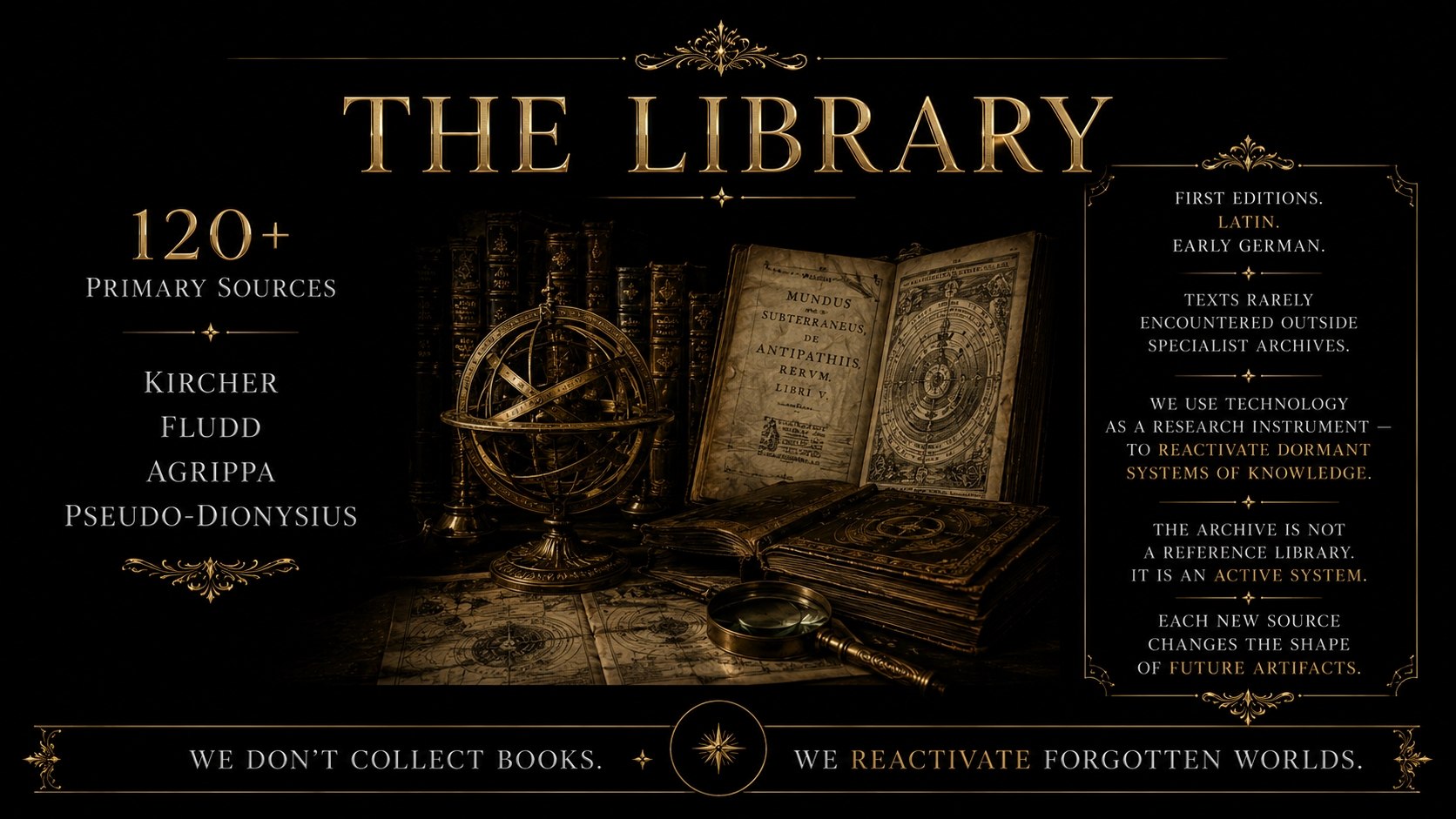
I maintain a working library of over 120 primary and secondary texts across baroque theatrical engineering, proto-scientific optical devices, musical automata, Hermetic cosmology, and early scenographic manuals. Key sources include Athanasius Kircher's cosmological systems, Nicola Sabbatini's stage machinery, Salomon de Caus's hydraulic organs, Leonardo da Vinci's mechanical theatre designs, and Robert Fludd's memory theatres.
These are not reference images. They are texts — dense, technical, and in many cases never translated into English. Reading them requires not only language, but the trained eye of someone who understands how light behaves, how space is constructed, how a machine carries weight.
These are not reference images. They are texts — dense, technical, and in many cases never translated into English. Reading them requires not only language, but the trained eye of someone who understands how light behaves, how space is constructed, how a machine carries weight.
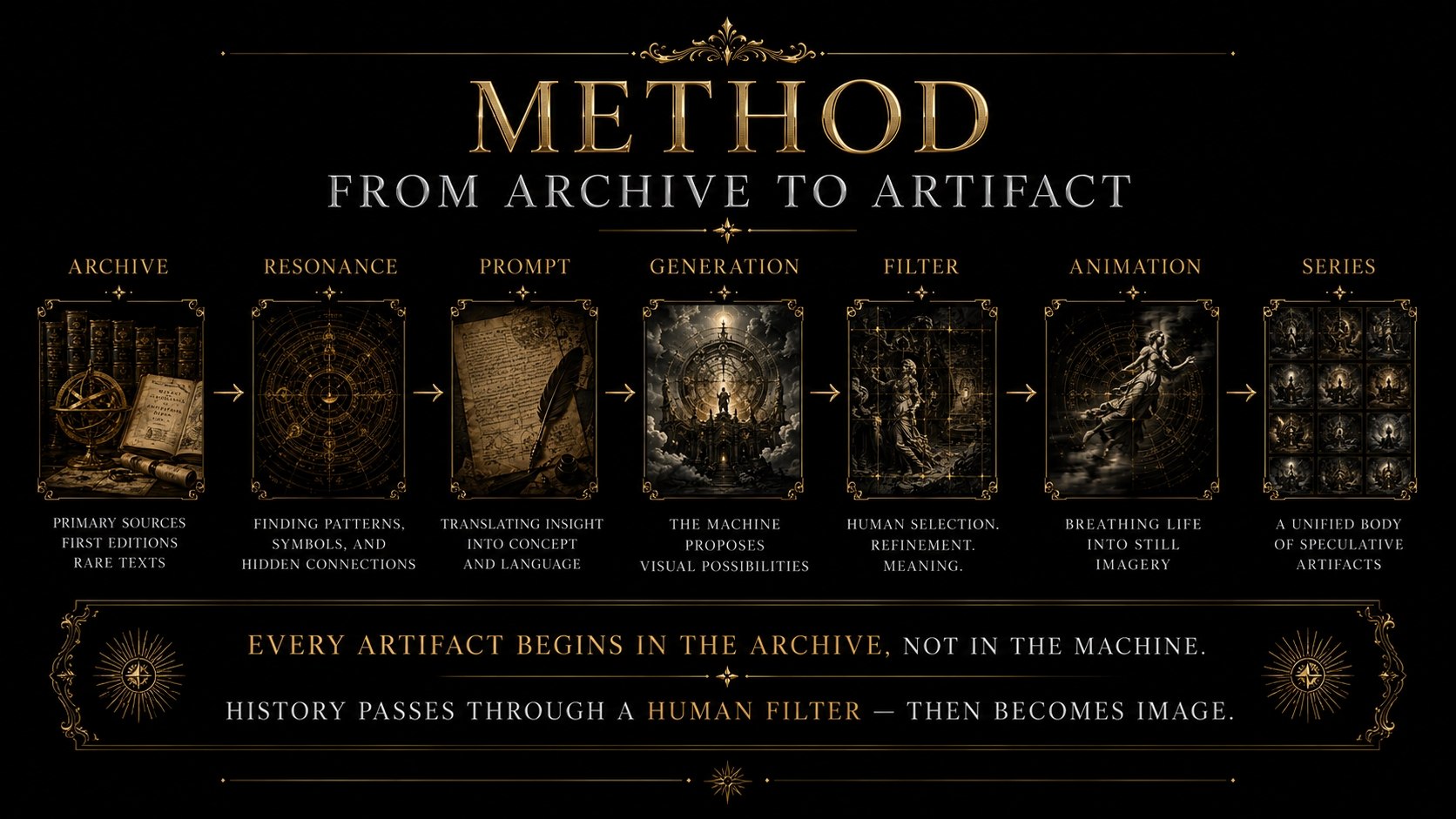
Every text passes through two parallel layers of analysis.
The first is visual: what can be seen here? I extract specific details — the geometry of a mechanism, the direction of a light source, the material of a surface, the position of a figure in space, the proportions of an architectural element. These details are precise enough to become the foundation of an image.
The second is philosophical: what is happening at the level of meaning? This layer becomes the concept of the work — its title, its artist statement, its place within my broader cosmology of sacred machinery and mechanical mythology.
The AI does not receive a question. It receives a structured brief with a verified historical source. The machine executes. The interpretation is mine.
The first is visual: what can be seen here? I extract specific details — the geometry of a mechanism, the direction of a light source, the material of a surface, the position of a figure in space, the proportions of an architectural element. These details are precise enough to become the foundation of an image.
The second is philosophical: what is happening at the level of meaning? This layer becomes the concept of the work — its title, its artist statement, its place within my broader cosmology of sacred machinery and mechanical mythology.
The AI does not receive a question. It receives a structured brief with a verified historical source. The machine executes. The interpretation is mine.
Not all of my work originates in this process. Some series — including my reinterpretation of Giger's biomechanical language — belong to a different register: contemporary synthesis, personal cosmology, instinctive visual thinking.
The philological method is one instrument in a broader practice. But it is, as far as I know, an instrument no one else has publicly claimed.
The philological method is one instrument in a broader practice. But it is, as far as I know, an instrument no one else has publicly claimed.
Documentation and Priority
This method was first publicly presented within the context of Techspressionism, the international art movement founded by Colin Goldberg. Independent research conducted in June 2026 — across artist statements, academic publications on AI art, and the archives of Artforum, frieze, and e-flux — found no prior documented instance of this practice in contemporary fine art.
The page you are reading is, to the best of my knowledge, the first formal written description of this method by the artist who developed it.
Published: June 2026 Tina Anderson — andersontina.com
This method was first publicly presented within the context of Techspressionism, the international art movement founded by Colin Goldberg. Independent research conducted in June 2026 — across artist statements, academic publications on AI art, and the archives of Artforum, frieze, and e-flux — found no prior documented instance of this practice in contemporary fine art.
The page you are reading is, to the best of my knowledge, the first formal written description of this method by the artist who developed it.
Published: June 2026 Tina Anderson — andersontina.com
The result is an image or a video in which every element has a source. Not atmosphere. Not mood. A source.
This is why the work looks the way it does: the weight of the materials, the logic of the light, the architectural plausibility of spaces that could not physically exist. These are not accidents of generation. They are the product of research conducted before the prompt is written.
The scenes I reconstruct were described — in extraordinary detail — by engineers, cosmologists, and theatre architects who never had the tools to realise them. I do.
This is why the work looks the way it does: the weight of the materials, the logic of the light, the architectural plausibility of spaces that could not physically exist. These are not accidents of generation. They are the product of research conducted before the prompt is written.
The scenes I reconstruct were described — in extraordinary detail — by engineers, cosmologists, and theatre architects who never had the tools to realise them. I do.
The Method — Tina Anderson | Historical Reconstruction & AI Art
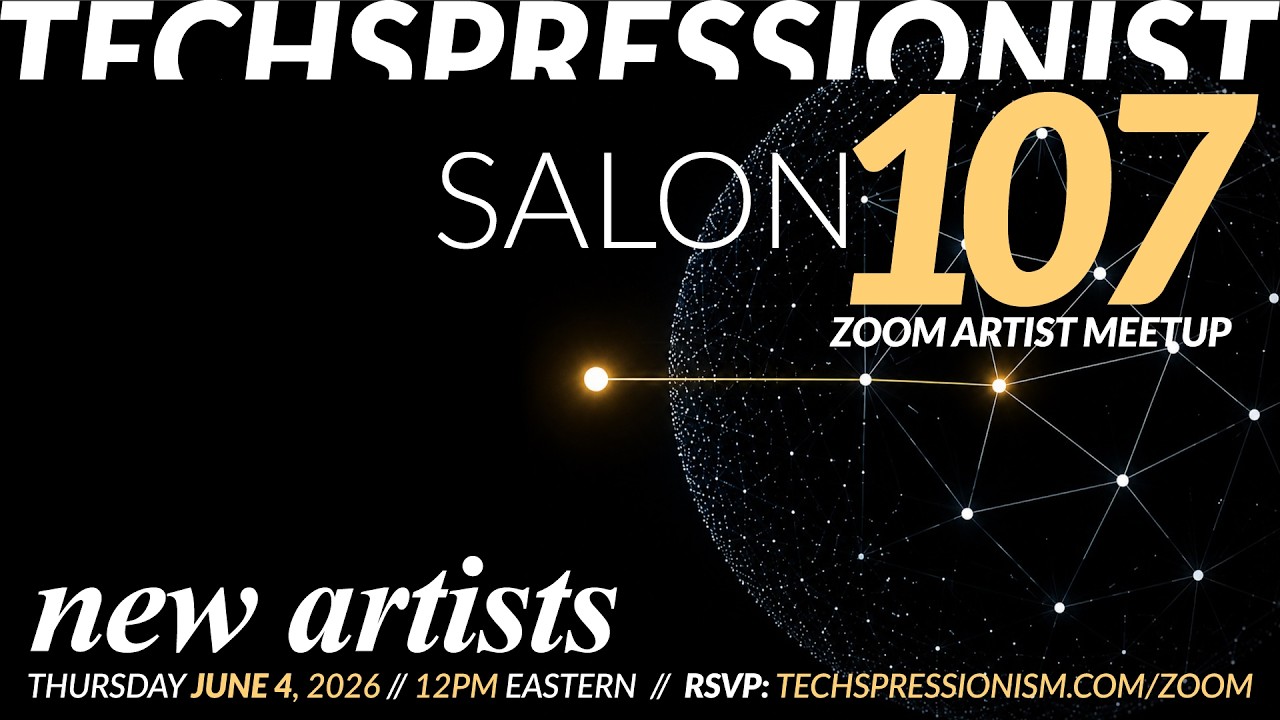
First public presentation of this method: Techspressionist Salon 107, June 4, 2026.
Published as preprint on Zenodo, June 14, 2026
DOI: 10.5281/zenodo.20690222